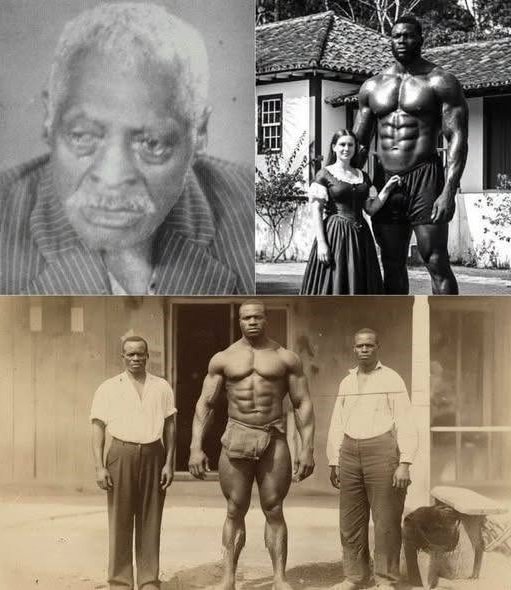
Pata Seca: The Enslaved Man Whose Body Became an Instrument of Exploitation — Part 2
Roque José Florêncio was likely born around 1827, although even this detail remains uncertain. Records of enslaved births were often incomplete, intentionally vague, or entirely absent. What is known is that he grew up within the brutal machinery of São Paulo’s slave economy, where human beings were moved, sold, and reassigned with the same indifference used for livestock.
Sorocaba, where he spent his early life, was one of the largest slave-trading hubs in the region. Merchants, farmers, and traders passed through regularly, inspecting, negotiating, and transporting enslaved people to plantations across the province.
For a child born into that world, identity was fragile. Names could change. Owners could change. Families could be separated without warning.
And yet Roque’s body made him impossible to ignore.
By the age of fifteen, he was reportedly around 1.80 meters tall—already taller than most grown men. By twenty, he had surpassed two meters. People did not need measuring tools to notice him. He stood out in every crowd, every field, and every line of workers.
His size became his defining feature in the eyes of those who controlled his fate.
But it was the combination of physical traits that fascinated buyers like the Viscount of Cunha.
Not just height.
Not just strength.
But proportion.
Roque’s unusually thin lower legs, compared with his massive upper body, became the center of speculation. In a world where superstition often replaced science, this physical difference was interpreted as meaningful.
Some believed it suggested a tendency to father more sons.
And sons, in the slave economy, were treated as currency.
This belief had no established scientific basis. It was a myth sustained by profit-driven imagination. Yet in the nineteenth century, myths that appeared to offer an economic advantage could be treated as truth long enough to justify transactions worth fortunes.
Roque was therefore reportedly purchased not simply for what he could do with his body, but for what others believed his body could produce.
What makes this story so haunting is not only the scale of exploitation, but also the way it was rationalized. The system did not rely on violence alone. It also relied on belief systems—false, convenient, and deeply embedded in economic thinking—that made exploitation appear strategic rather than cruel.