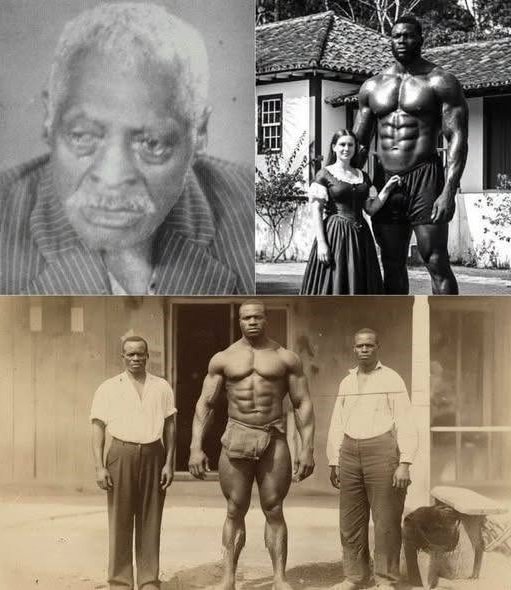
In 1849, in the heat of Sorocaba, São Paulo, a human being was not introduced as a person but as inventory. Not by name or personal story, but through measurements, assumptions, and a cold calculation of profit. The slave market was crowded that day, the air thick with dust and sweat, and the atmosphere filled with the quiet tension of men and women who knew that being looked at meant being judged, and being judged meant being sold.
Among them stood a 22-year-old man who would later be remembered not for who he was, but for what others believed he could be used for.
His name was Roque José Florêncio.
But history would strip that name away and replace it with something harsher, more dehumanizing, and strangely more enduring: “Pata Seca.”
A nickname that sounded almost absurd at first glance, until one understood the logic of the world that created it.
He stood 2.18 meters tall—approximately 7 feet 2 inches. In a society where most men barely reached the height of an average door frame, Roque looked less like an ordinary man and more like an anomaly of nature, someone people pointed at before they spoke to him.
His body carried the marks of brutal labor, with muscles shaped by years of forced work. Yet there was something unusual about the way he stood. His thighs were powerful, and his upper body was massive, but his lower legs appeared thinner, almost fragile in comparison.
In the twisted logic of nineteenth-century slave owners, that detail was not merely a curiosity.
It was an opportunity.
The man who noticed him that day was the Viscount of Cunha, one of the wealthiest landowners in the province. He had not come to the market simply to browse. He had come with a purpose, like a merchant selecting a tool.
Coffee plantations were expanding, wealth was concentrating, and enslaved people were treated as long-term investments. But even within that brutal system, Roque stood apart.
Not because he was strong.
Not because he was tall.
But because of what people believed his body implied.
There was a superstition among certain landowners and buyers, a pseudoscientific idea disguised as economic wisdom, that physical traits could predict reproductive output. A tall enslaved man with thin legs, they believed, would father more male children.
Male children meant labor.
Labor meant profit.
Profit meant power.
There was no scientific evidence behind this belief.
Only greed searching for justification.
The Viscount of Cunha reportedly smiled when he saw Roque. It was not a smile of admiration, but one of recognition—like a man spotting a rare instrument that might increase his wealth.
In that moment, Roque ceased to be seen as a human being by the system surrounding him. He became something else entirely: an asset with the potential to multiply wealth across generations.
The purchase was expensive. Exceptionally so.
But the Viscount did not hesitate.
In his mind, he was not buying a man. He was buying future generations.
And that is where the story of Pata Seca truly begins.
Because what followed was not simply a life of labor. It was a life shaped by a system that treated reproduction as economics, family as output, and human beings as instruments of expansion.